35,000+
Veterans watched how Kris did it
0% → 100%
P&T — Kris's own file, no records to start
$3,938/mo
What a 100% rating pays, no dependents, 2026 published rate
~15 min
From intake to Intel Report
What people are saying

What you'll get
Three things. All free. All built already.
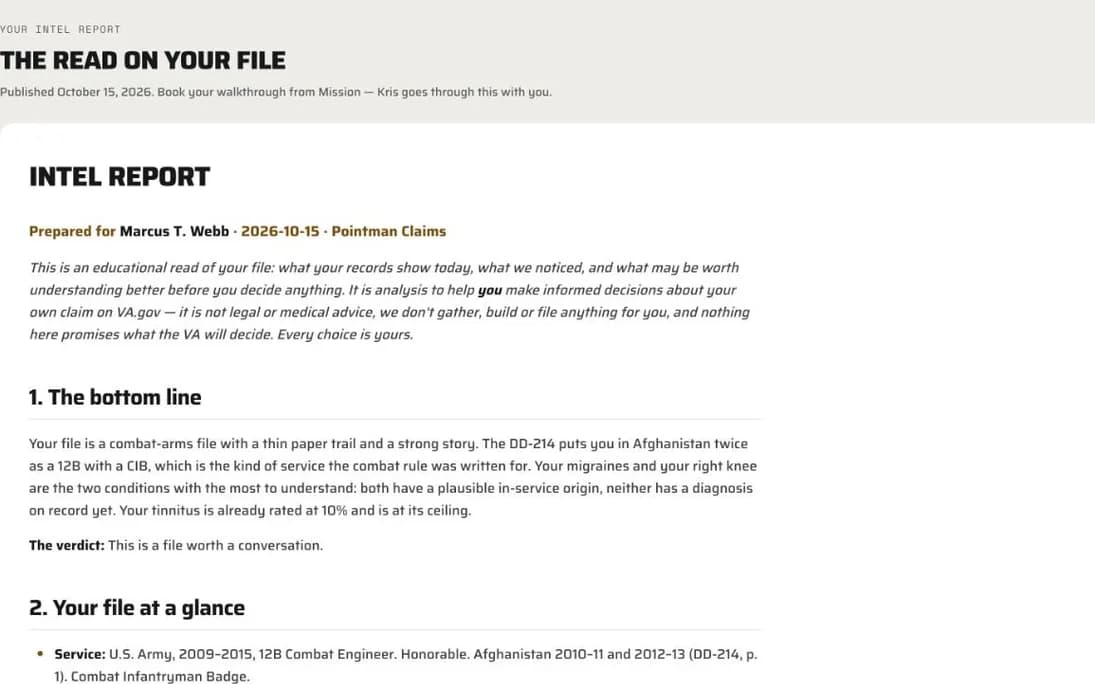
#1
The Intel Report
- Every condition: what your file shows, with the page
- What it doesn't show yet — the gap, named plainly
- The 38 CFR rule and diagnostic code, verified
- A one-line verdict, including “at your ceiling” when that’s true
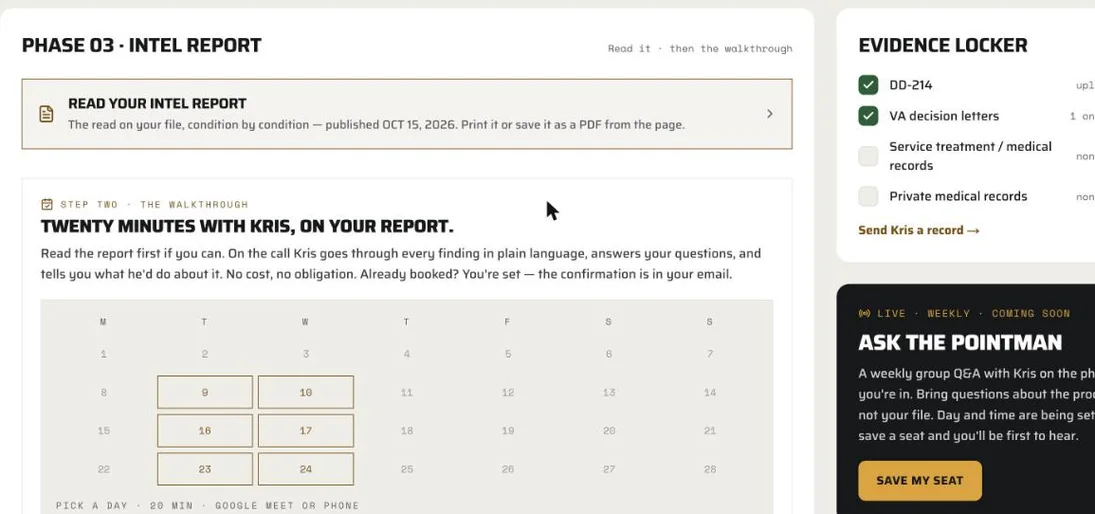
#2
Twenty minutes with Kris
- Booked from the report page, after you've read it
- Every finding in plain language, your questions answered
- What he'd do about it — and what he wouldn't
- No cost, no obligation, no pitch until you ask
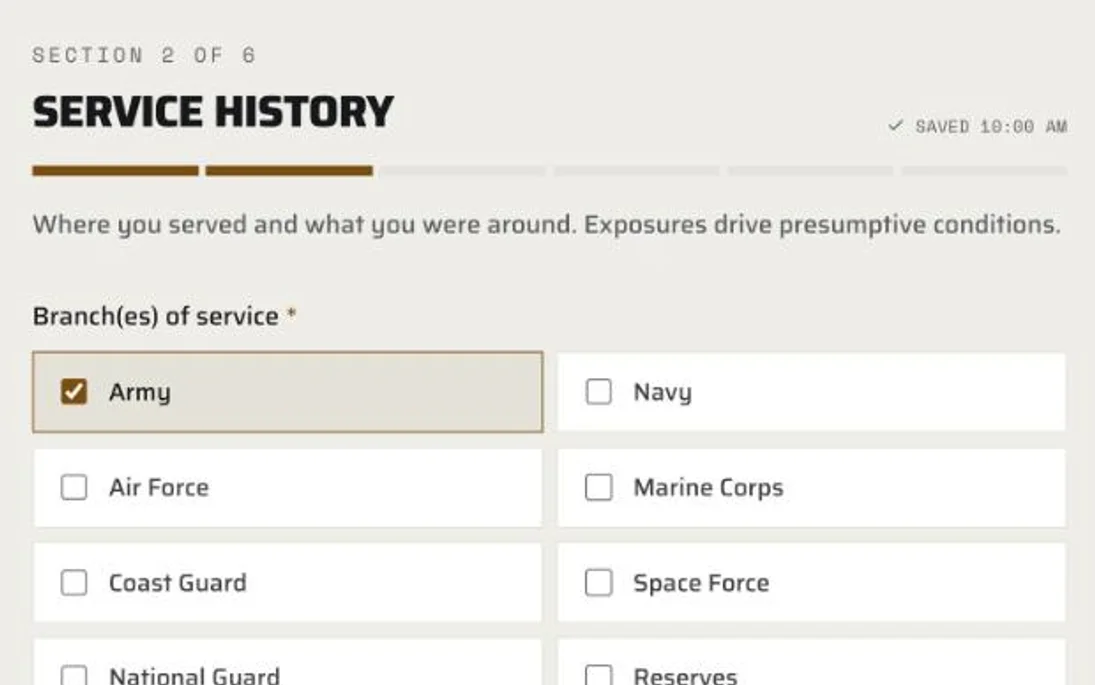
#3
A portal built for this
- A ten-minute intake that saves as you go
- Upload once — your records stay in your file, encrypted
- Watch the report being written, step by step
- Everything carries over if you ever go further
What's in the report
Not a checklist. Not a quiz. A read on your actual file.
Most “free VA tools” ask you five questions and tell you what you already know. This one reads your records — every page you give it — and writes five sections about your file.
The bottom line
The shape of your file in five sentences, and a one-line verdict: worth a conversation, fix two things first, or already at its realistic ceiling. We say the third one when it's true.
Your file at a glance
Service, exposures, every rated condition with its percentage (even the 0%s), what was filed before and why it went the way it did, and which records would help that only you can get.
What we found, condition by condition
For each condition: why it's on the table, what your file shows with the page it comes from, what it doesn't show yet, the 38 CFR rule and diagnostic code it runs on, and an honest read — strong, moderate or thin.
Clocks
Supplemental and Higher-Level Review windows counted from your denial dates, an Intent to File and when it lapses — anything on your file that is on a timer.
Where this goes from here
What the report is (the read) and isn't (the plan), what the walkthrough call is for, and what Tier-1 adds — written as information, not a pitch. You decide.
- Increase my rating (click here)
What it isn't
The report is the read on your file. It does not write your statements, lay out your filing order, or walk the C&P exam. That is the plan — Tier-1, Kris on your team — and the report tells you exactly where the line is.
How it works
Three steps. The first two take under an hour.
Ten minutes of intake
Click the link in your email, answer questions about your service and your conditions, and upload your DD-214 — required, it's where your dates, MOS and deployments come from. Add your VA decision letters if you're rated, and whatever else you have.
Your report, in minutes
The moment you submit, your file is read page by page and mapped against the rating criteria. The Intel Report lands in your portal about 15 to 30 minutes later, with an email.
Twenty minutes with Kris
Read the report, then book the walkthrough from the same page. Kris goes through every finding in plain language, answers your questions, and tells you what he'd do about it. Free, no obligation.
Who's reading it with you
0% to 100% P&T — starting with no records at all.
I'm Kris Green. 75th Ranger Regiment, three deployments. I got out with no medical records and no diagnosis on file and learned this system the hard way. The walkthrough is me, on your report, for twenty minutes. Here's the whole story in fourteen.
What you'll see
Your portal, start to finish.
This is the actual portal, not a mock-up — shown here for a fictional veteran. Yours looks the same with your name on it.
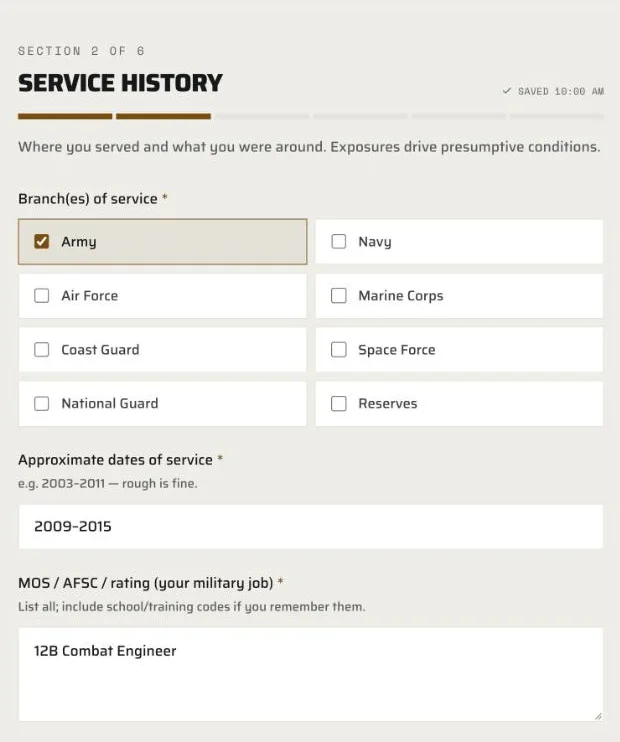
Step 1
Ten minutes of intake
Six short sections about your service, your VA status, your conditions and your records. It saves as you go, from your phone or your computer. Your DD-214 is required; decision letters if you're rated.
Step 2
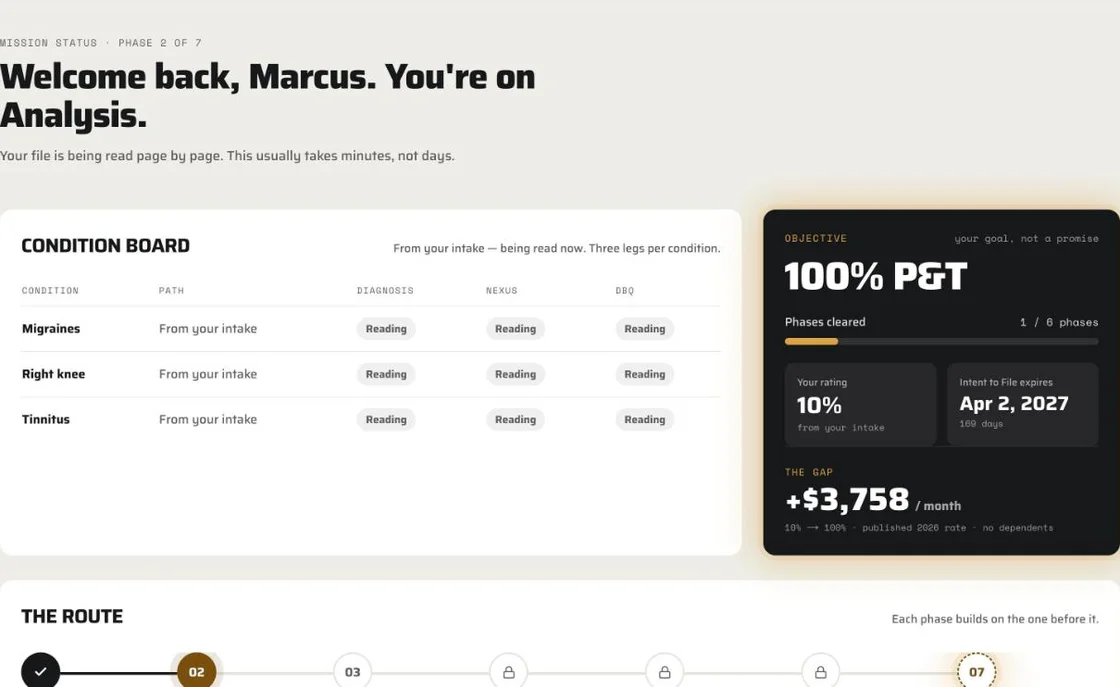
Your report is being written
Hit submit and watch it happen: intake received, documents read page by page, report being written. Usually fifteen to thirty minutes. You get an email the moment it lands.
Step 3
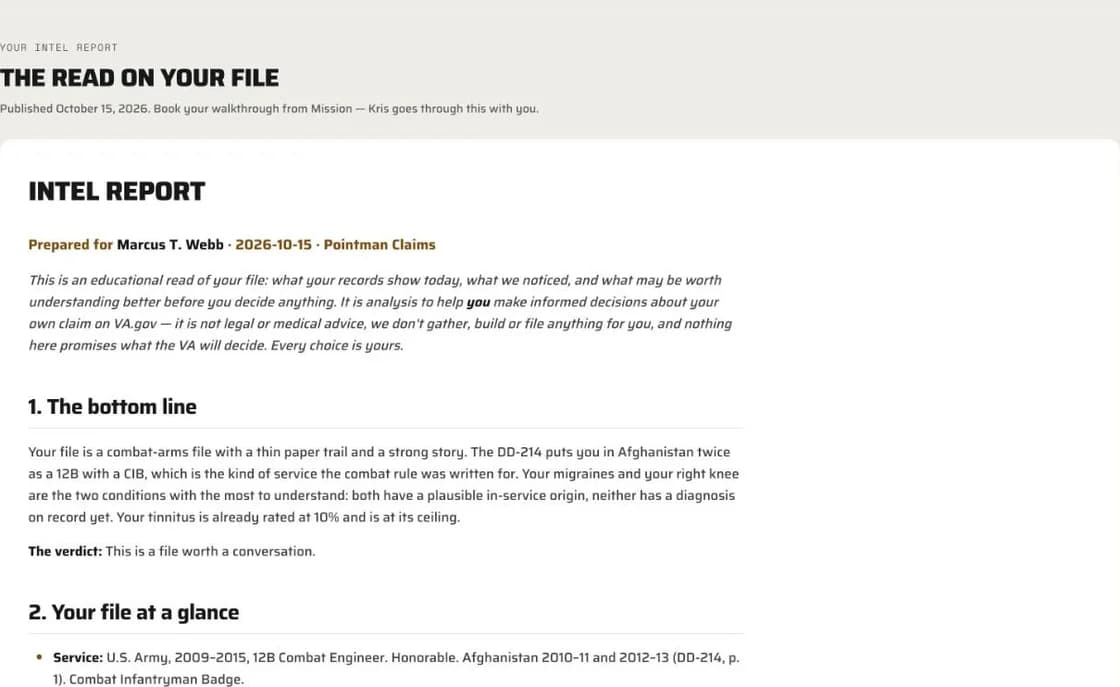
The read on your file
The bottom line, the verdict, your file at a glance, then every condition with what the file shows, what it doesn't yet, the rule it runs on and an honest read. Print it or save it as a PDF.
Step 4
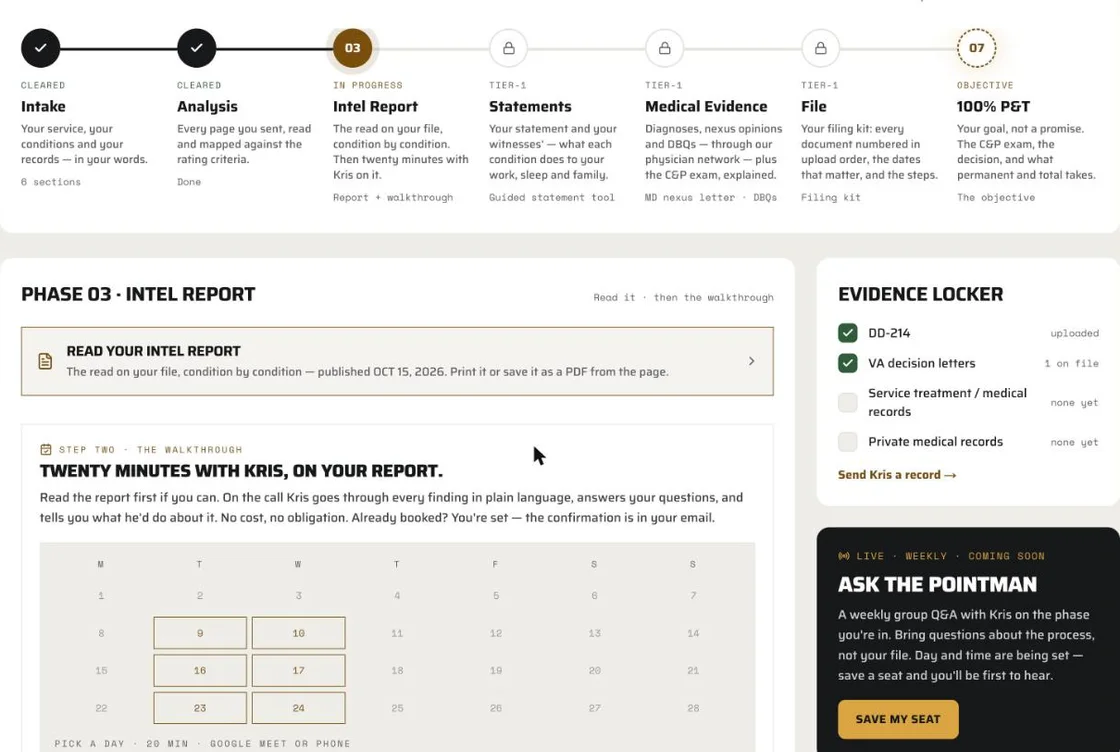
Then book your walkthrough
Once the report is in front of you, the calendar is right under it. Twenty minutes with Kris on your findings. Read it first; the call is better for it.
After the report · Tier-1
The report is the read. Tier-1 is Kris on your team.
If the walkthrough shows a path, Tier-1 adds everything the report stops short of: the plan condition by condition, exactly what each statement needs to say and who should write it, where the evidence tends to live, what to expect at the C&P exam, the course in your portal that checks each piece as you build it, a nexus letter and DBQ from a licensed provider through our physician network, and Kris on your claim through filing.
Your records and your answers carry over. Nothing to redo. And you only hear about it after you've read your report and talked it through.
Tier-1
$1,500
is what it costs to have Kris on your team, paid one time. That covers the full package, and we never take a percentage of your backpay.
Compared with the other ways
| Tier-1 | Claims consultants | AI letter services | Nexus letter mills | |
|---|---|---|---|---|
| Reading your file | Free — the Intel Report ($100 value) | $100+ for a records review | Not offered | Not offered |
| How you pay | $1,500, once | 5–6× your monthly increase ($5k–$15k) | Per letter | Per letter |
| Nexus letter + DBQ | Included ($700 value) | Extra | Letter only | $650+ for both |
| Who signs the nexus | A licensed provider | Varies — ask them | Ask them | Varies — ask them |
| Your statement + journals | Built from questions, checked by Kris | Templates | Not offered | Not offered |
| Who files | You, on VA.gov | They do | You | You |
| Follow-up claims | No new fee | 5–6× again, every time | Pay per letter again | Pay per letter again |
| Your backpay | 100% yours | A cut goes to them | Yours | Yours |
Typical advertised prices and terms, October 2026. Categories, not companies — ask any of them the same questions.
Questions
Straight answers.
- What do I need to have?
- Your DD-214 — the intake won't submit without it, because every date, MOS, deployment and award the report relies on comes from it. If you have a VA rating, your decision letters: they hold every rated condition, every denial and the exact reason, and the report is far sharper with them. Service treatment records and medical records help too. A thin file is still a file; no DD-214 is no file.
- Why is it free?
- Because it's the best way to show you what we do. The report is a real analysis of your actual file, not a sample. If it earns a conversation, the walkthrough is where we talk about the full review. If it doesn't, you still have the read on your file.
- Does a person read my records?
- Not on the free report. Your records are read and mapped by the same analysis engine that drafts every Pointman Brief, against a verified library of 38 CFR. Kris reads it with you on the walkthrough. When you upgrade to Tier-1, Kris is on every finding before it reaches you.
- What happens to my records?
- They're encrypted at rest in your file and never shared or sold. They're used for your report and nothing else. Ask us to delete your file at any time and we will.
- Are you VA-accredited?
- VA accreditation governs representing veterans before the VA — preparing, presenting or prosecuting a claim. We do none of that. Pointman provides pre-filing education and records analysis; you file your own claim on VA.gov and stay in full control of it.
- How is this different from a claims consultant?
- Three ways. We never take a cut of your backpay — Tier-1 is $1,500, once, where a consultant typically charges five to six times your monthly increase, often $5,000 to $15,000. The nexus letter and DBQ are included and come from a licensed provider through our physician network, where most consultants charge extra or leave you to find a letter yourself. And you file your own claim on VA.gov, so you stay in control and the full backpay lands in your account.
- What does it cost to work with you?
- $1,500 is what it costs to have Kris on your team, paid one time. That's Tier-1: the plan condition by condition, exactly what each statement needs to say and who should write it, the evidence map, C&P exam prep, the course in your portal that checks each piece, a nexus letter and DBQ from a licensed provider through our physician network, and Kris on your claim through filing. We never take a percentage of your backpay.